RECOMMENDATIONS
Disclaimer: The recommendations below are the result of a systemic anticipation approach specific to the GEAB. They do not represent personalised financial advice or investment incentives. In a context of high volatility and global transition, all investors are solely responsible for their decisions We recommend cross-checking these analyses with other sources and, if necessary, consulting a licensed professional.
AI – A shift towards sovereignty
Washington’s blocking of access to Anthropic’s latest models marks the end of the myth of AI as mere “frictionless” global software. Now treated as a critical sovereign technology, cutting-edge AI will face strict geopolitical restrictions and heavy administrative barriers (such as KYC – Know Your Customer). For investors, this implies a risk of a correction in the sky-high valuations of future IPOs (OpenAI, Anthropic), whose business models assumed immediate global roll-out. Favour essential hardware infrastructure and European solutions with local fallback plans.
Euro – French capital on the run Login
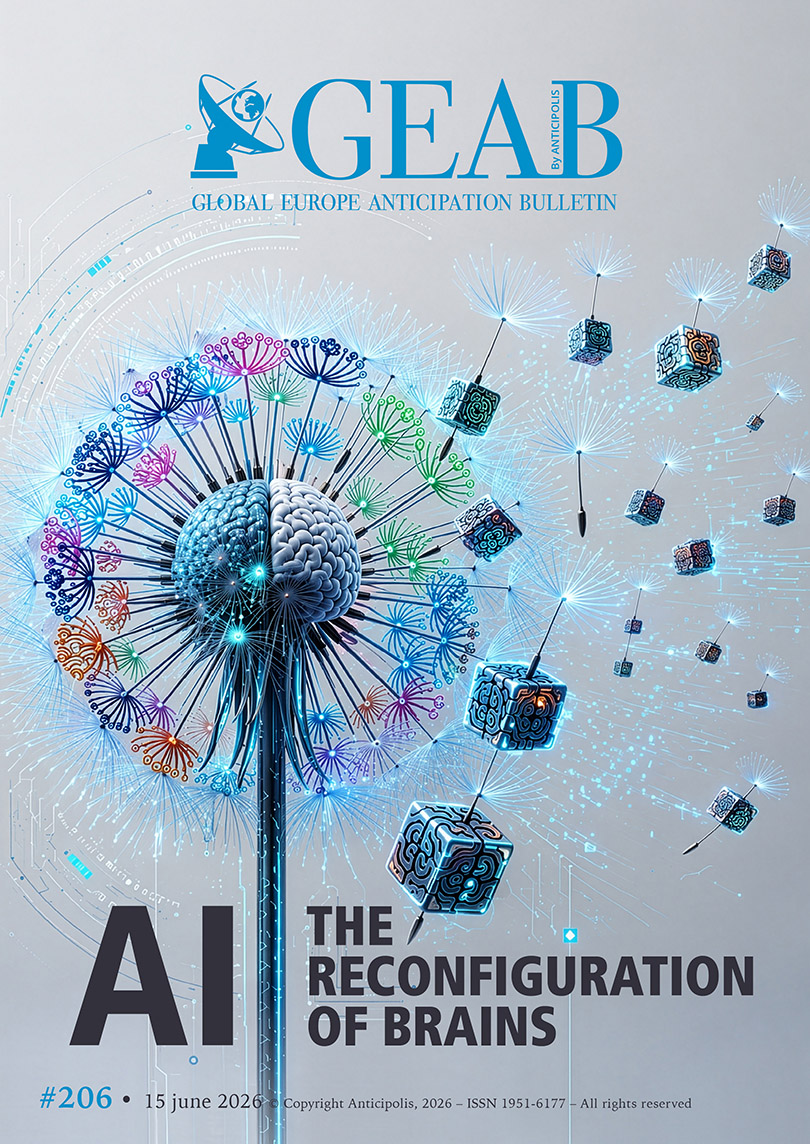
EDITORIAL Among the many ways AI is reshaping our lives, perhaps the most profound one concerns the way we think. Our brains now "benefit" from cognitive crutches transforming their very [...]
ANTICIPATION The rapid adoption of AIGs represents the greatest anthropological leap since the Neolithic era and the fundamental mistake made by contemporary analysts is to treat AI as a mere [...]
INTERVIEW After 30 years in technology, and more recently in blockchain, Federico d’Annunzio – an Italian aristocrat and entrepreneur, 4th Prince of Montenevoso and descendant of Gabriele d’Annunzio – is [...]
TREND Laetitia Hoquetis-Sheppard is Digital Transformation&AI Lead at the Baltic Defence College (BALTDEFCOL/NATO), Estonia. She has 13 years’ experience in behavioural science, data analysis and transformation consultancy, including roles at [...]
ANALYSIS Mihai Nadin is Professor Emeritus at the Ashbel Smith College, University of Texas at Dallas. His career spans engineering, mathematics, digital technology, philosophy, semiotics, theory of mind and foresight [...]
WEAK SIGNAL Christopher H. CORDEY is a Swiss futurist and maieutician, founder of Futuratinow and Prosilience, and a partner at gaming the future. He edits the mµtators series and works [...]
METHOD In recent years, narratives surrounding all sorts of conflicts have seen a remarkable resurgence of what was previously known as ‘agitprop’ (on the Soviet side) or ‘psy-ops’ (on the [...]
