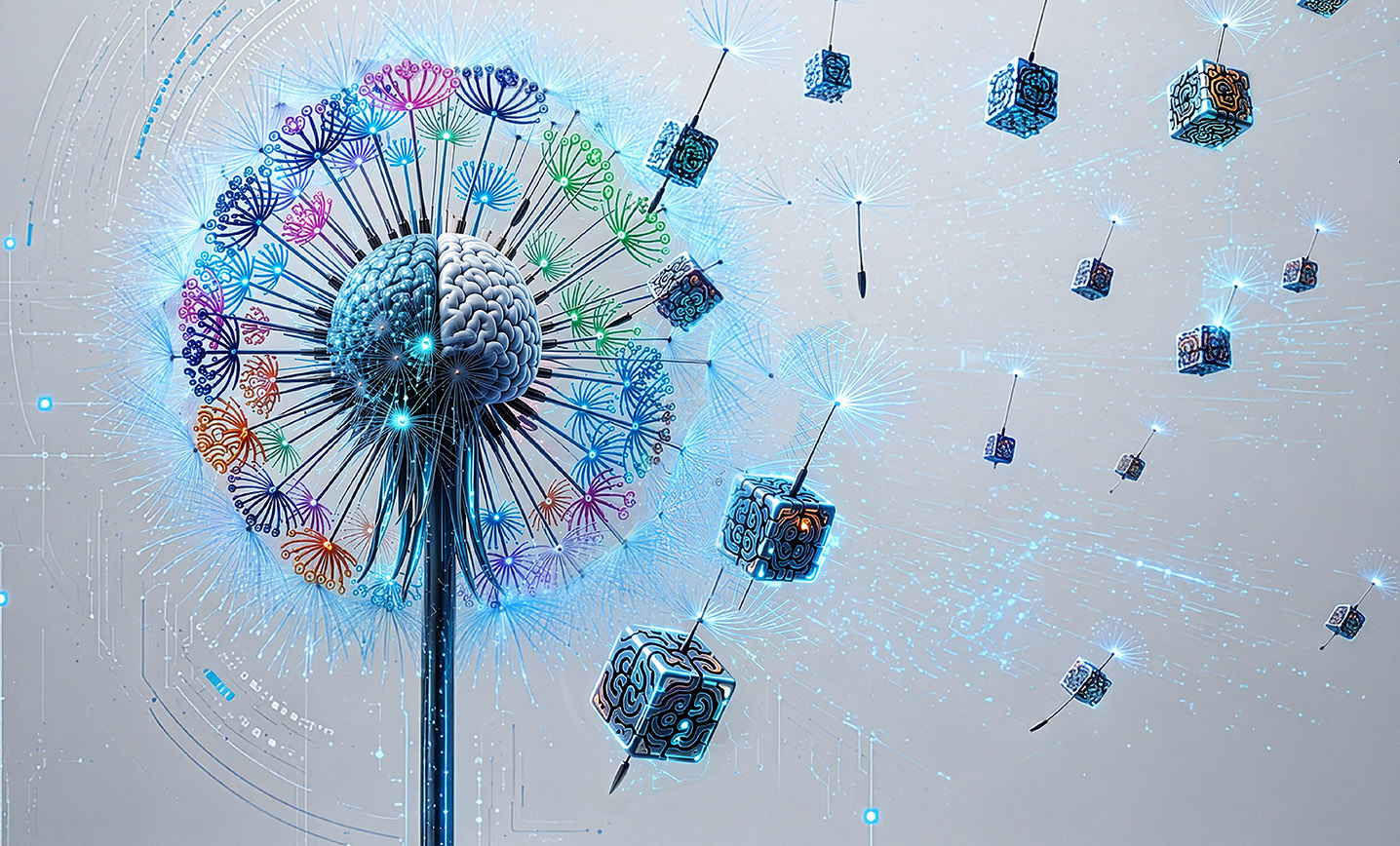
EDITORIAL
Among the many ways AI is reshaping our lives, perhaps the most profound one concerns the way we think. Our brains now “benefit” from cognitive crutches transforming their very musculature. Yet, rather than speaking of an impending cognitive collapse, we’d better examine, in concrete terms, how three years of gradual integration of large language models (LLMs) have begun to change our individual minds, but also our collective cognitive architecture. The first and perhaps most striking observation is the dramatic expansion of everyone’s capacity to write. If there was once a relatively small minority of people able to articulate complex ideas, writing has now become accessible to millions and is fundamentally altering the production and circulation of thoughts.
Indeed, a huge number of people who had ideas but were unable to express them in the past, are gradually joining the rather elitist (so far) editorial mechanism. On the other hand, let’s admit that those thoughts that are being expressed are theoretical, even philosophical, lacking a factual grounding – a characteristic reinforced by the fact that LLMs currently pay little to no attention to the diversity and nuances of sources. They help us to produce an ‘average idea’ at this stage, but finally these LLMs take control of our minds by making us believe that this average thought is our own. Moral biases are officially numerous in LLMs, which draw on data that has itself become much ‘cleaner’ since the terrorism crises of the 2015 and the conspiracy theories of the 2020s (bearing in mind that the moral foundations of these biases can change, insidiously). Generative AIs are therefore ‘educating’ the masses in a form of shared rationality and ethics. Schools did nothing else, and we certainly need to rebuild a community of thought and values to rebuild society… but the risks of abuse and excess are obvious and, in the context of current geopolitical and cultural tensions, these excesses are on the world’s agenda for the years to come.
Another trend we wanted to highlight here is the changing landscape of listening and reading habits. If everyone is potentially becoming a writer, will there still be readers?
The model towards which we are heading in the coming years would be that of a society surfing a mass of snippets of information (mainly article or report headlines) freely interpreted by everyone, generating an ocean of personal analyses conveyed via ephemeral social networks, and produced by individuals nurturing ultra-personal spheres of thought, all of which is subject to a centripetal force driven by the AI assistants that generate the ‘average thinking’ mentioned above.
The final point concerns our growing familiarity with texts that are clearly generated by AI. On the one hand, we are learning to use these LLMs, which themselves stick to the substance and style of our inner thoughts, producing texts that are increasingly ‘readable’ and seemingly ‘personal’; and on the other hand, well, we are getting used to this new form, which is becoming the norm, with an introduction, a body and a conclusion, few examples, clear or even simplistic ideas, and at the same time a style that is often corporate or even consultant-like. And little by little, the imperfection of human texts makes us prefer the stylistic and logical reliability of AI texts… just as in past times, we came to prefer printed type to the sumptuous cursive of the manuscripts of yesteryear – which, it must be said, had gradually turned into shapeless scrawls as writing became widespread. All this sets the stage for a question that concerns us, and you, the readers of the GEAB:
How can the press and their readers continue to provide and get what nourished their relationship?
The nature of this link is certainly different depending on whether we are talking about the mainstream media, which we read to obtain factual information and to hear what the powerful of this world want us to understand, or media such as the GEAB, which we believe serves essentially two purposes: on the one hand, to access an alternative, questioning perspective (the ‘stereo’ of intelligence) and, on the other hand, to read content that aligns with one’s own thinking, which differs from what the prevailing orthodoxy produces and which one is happy to find already written and published. It is precisely on this last point that the purpose of a publication like the GEAB is at risk: thanks to AI and social media, our readers are now able to write and publish for themselves what they wanted to read here but lacked the time or courage to do so.
The avenues for reinventing the media, whether mainstream or niche, revolve around two themes: grounding and community. As for grounding, we will continue to need to read to nurture our thinking; and we will increasingly need data that serves us directly as citizens or professionals. The mainstream media will therefore have to rebuild their credibility and the reliability of their sources (they have already started) AND bring their criteria for selecting information closer to people’s lives (that, however, they have not yet achieved). For example, we believe that local news media, specialist media, etc., have a bright future ahead of them because the media will have to start talking to us again about events over which we have some degree of control, in order to meet our needs and begin to reduce general anxiety.
This grounding argues, for example, in favour of a refocusing on Europe in the case of the GEAB…
The other theme is community: we will continue to want to read about people with whom we share an identity, a type of analysis, a project, an activity, an organisation, and the mainstream media will not be able to play much of a role on this second point. On the other hand, this is the strong point of non-mainstream media such as ours. You, our readers, have in common the fact that you have found us, that you feel in tune with our independent analysis, our broad and systemic perspective, our forward-looking courage, and so on. Yet this shared mindset, combined with the AI that now helps you to write, could justify our magazine’s pages opening up more resolutely to you, to ‘your understanding of the future’…
I shall say no more at this stage, leaving you with this thought and inviting you to share with us what it inspires in you via this form: “What will become of the reader?”. The summer will pass and we shall see how these lines of inquiry take shape in September. Until then, let’s stay in touch via the reviews and newsletters and any surveys we may well send your way.
Have a wonderful summer holiday, everyone!

Marie-Hélène Caillol,
Managing editor, co-founder of the GEAB
To access the full issue, please log in or register here
ANTICIPATION The rapid adoption of AIGs represents the greatest anthropological leap since the Neolithic era and the fundamental mistake made by contemporary analysts is to treat AI as a mere [...]
INTERVIEW After 30 years in technology, and more recently in blockchain, Federico d’Annunzio – an Italian aristocrat and entrepreneur, 4th Prince of Montenevoso and descendant of Gabriele d’Annunzio – is [...]
TREND Laetitia Hoquetis-Sheppard is Digital Transformation&AI Lead at the Baltic Defence College (BALTDEFCOL/NATO), Estonia. She has 13 years’ experience in behavioural science, data analysis and transformation consultancy, including roles at [...]
ANALYSIS Mihai Nadin is Professor Emeritus at the Ashbel Smith College, University of Texas at Dallas. His career spans engineering, mathematics, digital technology, philosophy, semiotics, theory of mind and foresight [...]
WEAK SIGNAL Christopher H. CORDEY is a Swiss futurist and maieutician, founder of Futuratinow and Prosilience, and a partner at gaming the future. He edits the mµtators series and works [...]
METHOD In recent years, narratives surrounding all sorts of conflicts have seen a remarkable resurgence of what was previously known as ‘agitprop’ (on the Soviet side) or ‘psy-ops’ (on the [...]
RECOMMENDATIONS Disclaimer: The recommendations below are the result of a systemic anticipation approach specific to the GEAB. They do not represent personalised financial advice or investment incentives. In a context [...]
