GEAB 208
EDITORIAL
The bursting of the AI bubble is certainly cause for concern. But there is something worse: that it might not burst at all...
In two weeks’ time, Europe will celebrate Halloween, this dark festival from across the Atlantic with a massive influx of unnecessary consumption. Seeing the first unwrappings of these horrible, skull-shaped plastic pumpkins, I can’t help but compare the imagery on which America placed itself at the centre of the ‘free world’ in the 1950s with the one on which it has been killing both freedom and the world since the 1990s. I choose my words carefully.
What if the tech bubble never burst?…
The great future-crusher is running at full speed, and even the GEAB despairs of seeing what could stop it. The mad dash in which the US has emarked, forcing the entire world to follow suit, and consisting of absorbing almost all of the planet’s most vital resources (money, energy, water, air, human lives) to plough them back into a delusional project of absolute global technological domination, is accelerating… as if that were still possible.
The most recent example prompting us to issue such an existential warning relates to the 75 billion raised by SpaceX’s IPO last June, combined with the 62% of foreign direct investment in high technology that the United States alone attracts[1] – whilst social, health and education systems are collapsing, as are purchasing power and the hopes of prosperity in emerging economies, and states unable to cope with such a level of mismanagement, etc.
Officially, all this money is being used to build the big data infrastructure needed to further enrich emerging economies[2]. To ensure that the internet – which has become a veritable data vacuum cleaner – can reach the furthest corners of the planet, it seems that it is absolutely essential to supplement terrestrial fibre-optic infrastructure (the installation of which has already cost a fortune) with satellite constellations, notably those of Mr Musk (but also Mr Bezos’s Amazon Leo project, …).
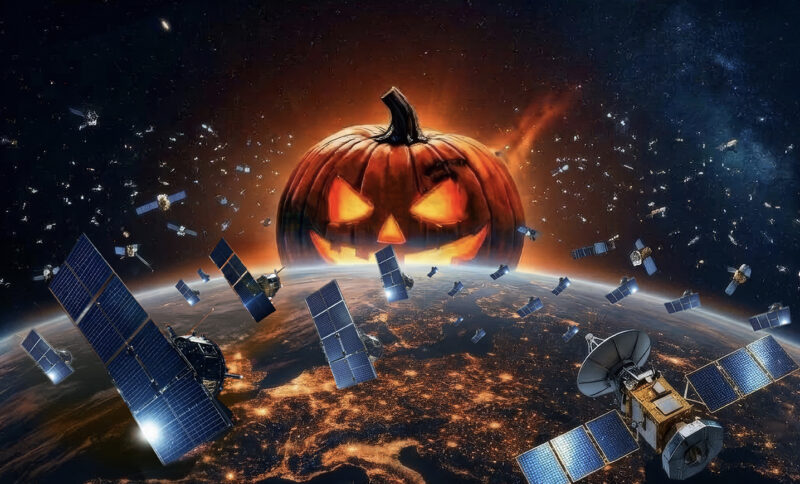
But did you know that these satellites have a lifespan of just 5 to 7 years?! And that 5 years after they cease to function, they must[3] be disposed of to avoid ‘Kessler syndrome’ – a disaster scenario in which the accumulation of space debris causing a chain reaction of collisions would render Earth’s orbit completely unusable. To achieve this, operators deliberately send them hurtling into the upper atmosphere, where they vaporise due to extreme friction.
But this method of space clean-up poses a major environmental risk: as they burn up, these thousands of tonnes of metal release nanoparticles (notably alumina) which accumulate in the stratosphere and threaten the integrity of the ozone layer[4], undermining the greatest environmental success of international diplomacy, namely the 1987 Montreal Protocol. It is worth recalling, however, that the hole in the ozone layer threatened nothing less than life on Earth in the short term, with a surge in skin cancers, cataracts, and above all the destruction of phytoplankton, which forms the basis of the marine food chain.
However, by 2030, given the number of applications submitted to the International Telecommunication Union (ITU)[5] and industry projections, it is estimated that between 50,000 and 100,000 satellites could be in low Earth orbit[6] (and SpaceX is expected to account for 50% – 70% of the global total of telecommunications satellites[7], bearing in mind that it currently accounts for 70%!).
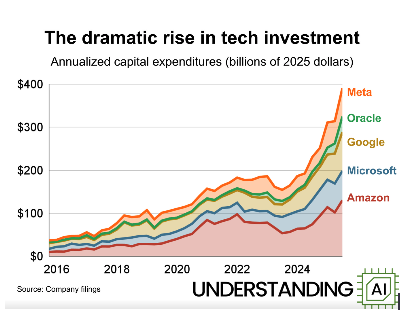
The worrying rise in technological investment – Source: Company filings, 2025
We’re talking about hundreds of billions of dollars, of course, to launch all this into space. And every ten years, we burn it all up just to start all over again?
The financial markets are no longer enough. It took the wars in Ukraine and Iran for tech players to gain access to unlimited public military budgets that are not subject to parliamentary scrutiny[8]. What will need to be invented in 2030 to continue this Grand Plan?
Wars, deadly pollution, the misappropriation of wealth… this is the reality behind the fine promises of a technology now in the hands of transhumanists in search of eternal life, leaving a trail of death and destruction in their wake.
The cynicism has gone so far as to turn Halloween – this holiday in anticipation of the end of the world – into a children’s festival…
Earth, we have a problem.

Marie-Hélène Caillol,
Editor-in-Chief, co-founder of the GEAB
To access the full issue, please log in or register here
___________________
[1] Source: UNCTAD, 25/08/2025
[2] US backing, an African pretext… the same mechanisms lay at the heart of the scandal surrounding FIFA’s plan to open up to private investment – as if FIFA didn’t already rake in enough money, and as if Gianni Infantino’s annual salary of 2 million – plus a bonus of 1.6 million euros linked to the World Cup in Qatar – weren’t enough.
[3] At the request of the FCC since 2022. Source: FCC, 2022,
[4] Source: University of Groningen, 26/02/2026
[5] In 2023, the Outer Space Institute noted that 1 million ‘paper’ satellites were registered with the ITU. Source: OSI, 2023
[7] Source: LookUpSpace, 2/06/2026
ANTICIPATION An important presidential election will take place in 2027, the election of the next French president, who will inherit a stratospheric debt, a geopolitically weakened France and a major [...]
TERRA COGNITA 2089 Terra Cognita 2089 is a project mapping the medium to long-term future as it takes shape through the strategic documents of major emerging players. These documents are [...]
ALERT The global economy is heading towards a period of major turbulence by 2027. Whilst official statements seek to reassure by referring to a ‘soft landing’, a convergence of financial, [...]
STRATEGY In August 2026, the Standing Committee of the National People’s Congress of China submitted the Draft Anti-Cross-Border Corruption Law for its first reading. This bill marks Beijing’s first unified [...]
RECOMMENDATIONS The recommendations below are the result of a systemic forward-looking approach specific to the GEAB. They do not constitute personalised financial advice or investment advice. In a context of [...]
