VISION
Mr. Adrian Taylor is a strategy and foresight consultant, specialised in helping clients understand the changing business environment, and developing their own strategies through participative methods. His boutique consulting company is called ForeSight to Strategy for Security and Sustainability in Governance (4SING) and this name already indicates his particular interest in the topics of security and sustainability. He is joined by Ms Anna-Magdalena Taylor, his daughter, a student in Environmental Humanities at the University of Exeter with a strong interest in resource and energy governance, particularly motivated by the challenges of transition that balances sustainability and social equity.

This text is co-authored as part of a partnership between Anticipolis and 4SING, and reflects an intergenerational dialogue between strategic experience and new approaches to environmental issues.
Mitigation measures have been implemented, but change is technically challenging
Although the need to deal with climate change has been a substantial point of the global political agenda for years, with the Paris Agreement likely being its high point, it has proven difficult to make progress on the ground. Of course, Europe, China, India, the US and now even countries like Saudi Arabia, have rapidly accelerated the introduction of renewable energies and electrification of energy supply over the last decade (although the Trump administration is now trying to stop this in the progress in the USA). But at the same time, global demand for fossil fuels has never been higher[1] (given the world economy has grown), and China, India and (to a lesser extent) the US, are still reliant on coal as a primary energy source[2], and Saudi Arabia (and others)[3] see renewable energy use at home as a means to extract more rent from oil (given the price of a barrel sold abroad fetches a far higher price than when it is sold at home)[4].
Login
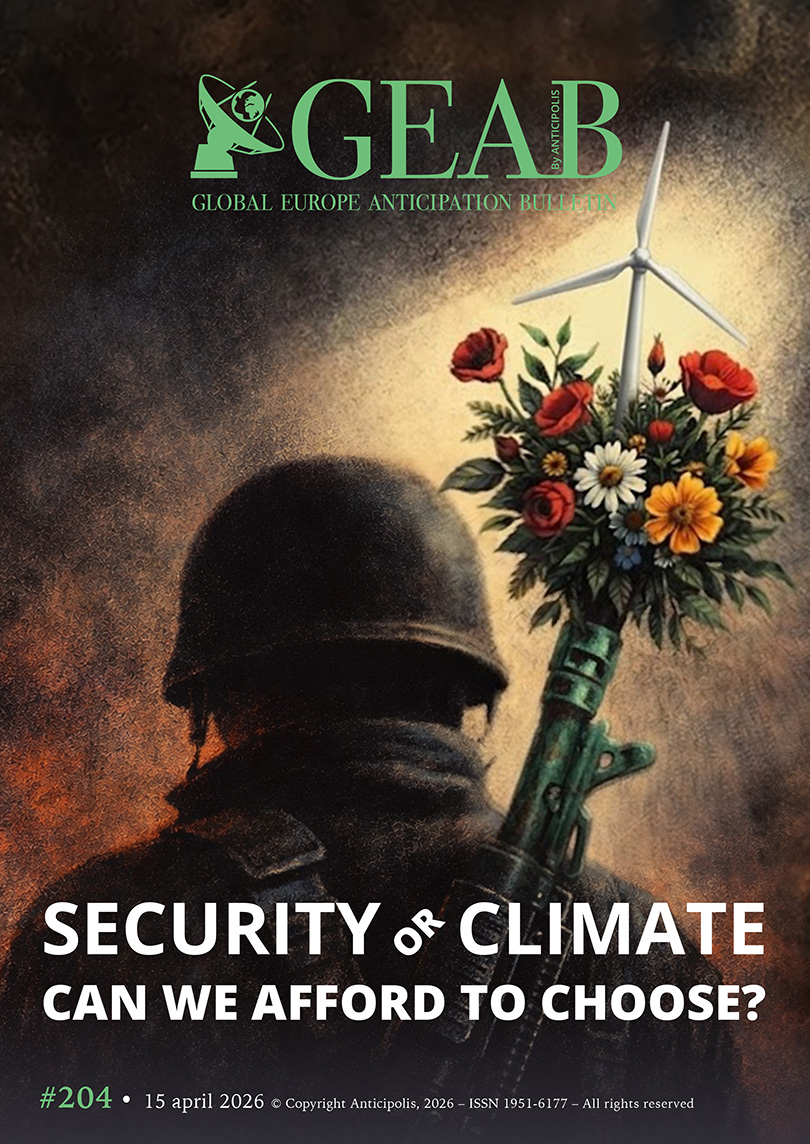
EDITORIAL As a political priority, climate change has lost momentum in the last years, not least as hard security concerns have taken centre stage. But climate change, and wider environmental [...]
ANALYSIS On 30 March, we issued a “warning” regarding US Treasury auctions that were likely to fail around 8–9 April. Poor sales – meaning that US debt can no longer [...]
RETRO-ANTICIPATION Twenty-nine years ago, Prof. Mihai Nadin, in his book The Civilization of Illiteracy, described the end of literacy. Reading and writing in what is called natural language. Reading and [...]
WEAK SIGNALS Geo-agriculture: From adaptation to systemic exhaustion During one of his recent radio appearances, agroclimatologist Serge Zaka spoke of a form of ‘great replacement’ - applied to living organisms, [...]
Disclaimer: The recommendations below are the result of a systemic anticipation approach specific to the GEAB. They do not represent personalised financial advice or investment incentives. In a context of [...]
