
ANTICIPATION
“Nothing is lost, nothing is created, everything is transformed.”
Lavoisier’s formula now better describes the transformation of war than chemistry.
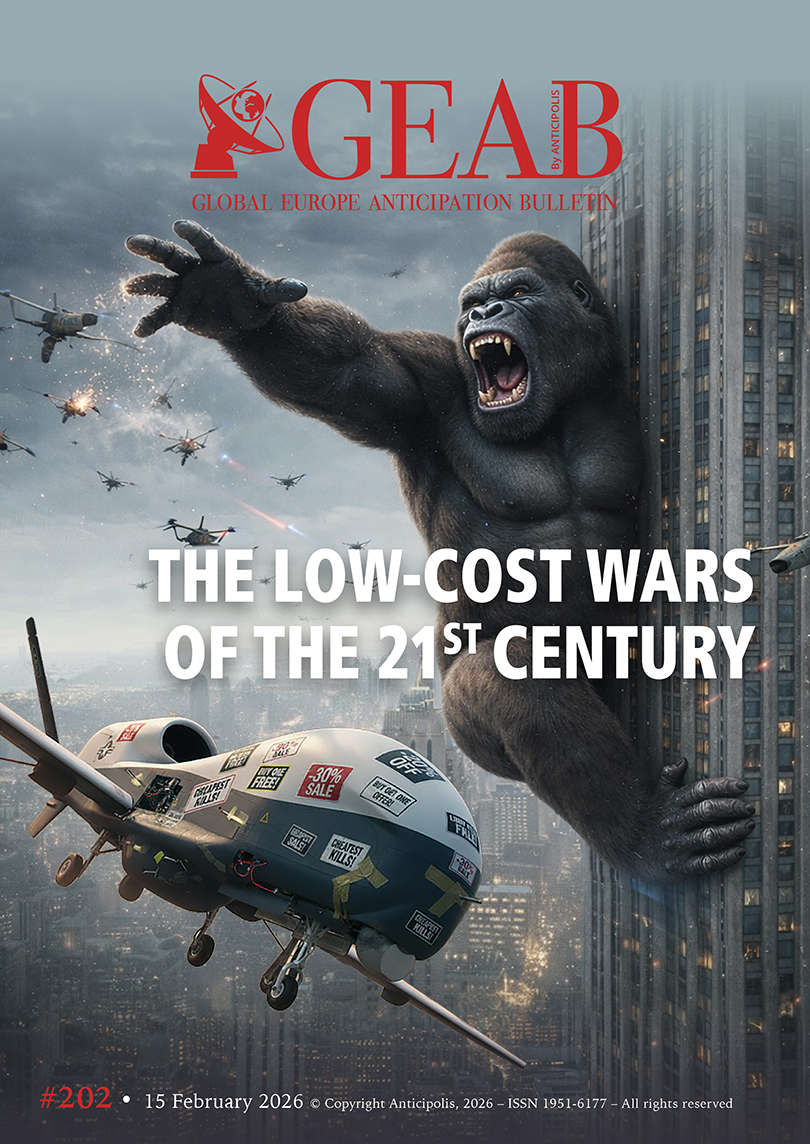
In the 21st century war has not disappeared sadly, it has simply changed its logic, no longer decided by a decisive military clash, but by a state’s ability to sustain a prolonged effort, to produce under pressure and to absorb industrial attrition without collapsing. We anticipate that future conflicts will be less spectacular, but longer, more diffuse and more economically destructive. This is why technological superiority will no longer be enough to guarantee victory.
Take recent conflicts, from the Sahel to the Middle East, and from Sudan to Yemen. These are not a series of isolated crises, but a new model of conflict in which immediate military victory is no longer central. Nowadays, production chains, stocks, logistics and industrial resilience determine the outcome of a confrontation. The best example is Ukraine, where, in three years, the country has gone from a Soviet-era army to a distributed war economy capable of producing 5 million FPV drones per year[1], with more than 200 manufacturers involved and 2 million units already rolling off the production lines in 2024. Between June and December 2025, Ukrainian unmanned systems forces alone claim to have hit nearly 200,000 targets, inflicting approximately 20 billion dollars in damage on Russia, equivalent to the annual military budget of several European states[2]. We believe that war has once again become a test of systemic strength, rather than a tactical confrontation. The outcome of future conflicts will be decided less in the headquarters than in the factories.
Login
EDITORIAL Every generation believes it can command time, until reality laughs back. Today, that laughter is bitter, carried by endless wars, chaotic diplomacy and provocations hurled like confetti in a [...]
VISION If we are talking about training super-collaborators, super-teachers and super-students, it is time to address the issue of the framework for this super-community and the school, which must obviously [...]
TREND For years, we have been observing the expansion of work far beyond its official boundaries and, with it, a widespread fatigue that neither traditional holidays nor the promise of [...]
RETROFUTURE The digital 21st century did not arise one morning as a technological miracle. It was slowly built in the fractures of the 20th century, in the silence of top-secret [...]
Disclaimer: The recommendations below are the result of a systemic anticipation approach specific to the GEAB. They do not represent personalised financial advice or investment incentives. In a context of [...]
