RETROFUTURE
The digital 21st century did not arise one morning as a technological miracle. It was slowly built in the fractures of the 20th century, in the silence of top-secret military laboratories and, above all, in the tightly locked drawers of the Cold War, where strategic urgency often took precedence over ethical considerations. There is no doubt that artificial intelligence (as well as the omnipotence of technology), as we know it, is the worthy heir to progress born of fear and eternal East-West rivalry.
Now that everything is connected, shaping our economies and policies (even our private lives) through GAFAM[1], a clear-eyed look in the mirror of the past raises an essential question: are we finally building tools that serve society, or are we continuing, this time in digital form, the logic of confrontation and obsession with power that has already brought the world to the brink of collapse?
To answer this question as best we can, we will devote the following pages to a brief history of digital technology.
The “portal to the past” wide open
After the end of the Second World War, the fall of the “Iron Curtain” on the European continent marked the great division of Europe into two spheres of influence, with diplomatic and military tensions between the socialist bloc and the free world reshaping mentalities and the idea of scientific and technological progress in ways that few had previously envisaged.
The great humanitarian catastrophe of 1939-1945, which claimed 80 million victims[2] and caused immense material losses, did not make our world safer or wiser. It even sowed the seeds of a potential third conflict we have not yet completely escaped.
Moreover, it is precisely in this historical interlude, amid the still-smouldering ruins, that a new dynamic is emerging, driven by dreamers and visionaries who understand that tomorrow’s security depends not only on humanity’s ability to defend peace through powerful and effective institutions such as the UN or NATO, but also on our collective will to put the planet’s science & technology at the service of our precious global stability. With this noble goal in mind, a plethora of scientists threw themselves into this project with all sails set – or rather, with all canvases, matrices and drawings out – before, sadly, the nobility of peace was quickly replaced by the grim reality of war.
A few names of visionaries emerged after 1946, and most of their visions of the future ended up on a long waiting list for better days… and funding, of course. The British Alan Turing (1912-1954), faced with the challenge of Enigma, sensed that machines could extend human intelligence, and the American Vannevar Bush (1890-1974) – one of the masterminds behind the Manhattan Project (on nuclear fission) that would give the United States the atomic bomb – dared to believe that science could serve peace, anticipating the Internet and hypertext with his Memex[3]; Norbert Wiener (1894-1964), founder of cybernetics, understood very early the technological potential for improving human safety with the help of AI, while John von Neumann and Nicholas Metropolis, architects of modern computers, produced the MANIAC computer in 1956 to help humans become stronger and faster. It was the first computer to beat a human being at chess; they chose this name in the hope of putting an end to the proliferation of absurd acronyms for machine names.
However, it seems that the use of technological progress for exclusively peaceful purposes had not yet been realised at that time. Many projects, initially developed to promote future development, were suspended or redirected towards ambitions such as the military field, as evidenced by the advances made by MANIAC in accurate and in-depth thermonuclear calculations.
The future of beauty and justice had to wait, as comfort and ease were clearly not priorities. A delay that was undoubtedly not a hasard…
Technology in the service of progress, a colossus with feet of clay
British philosopher Bertrand Russell (1872-1970), winner of the Nobel Prize for Literature in 1950 and also a great visionary, had already warned that technology without ethics[4] would undoubtedly destroy humanity. Did he know that certain buried innovations would eventually emerge and threaten the balance of the world[5]? On 5 March 1946, in Fulton, Winston Churchill announced that “an iron curtain has descended across the continent”[6]. The Cold War began, visions of the future were reorganised and science was largely put at the service of the strategic confrontation between Washington and Moscow… and the development of advanced computing, primarily for military purposes, became the top priority.
In the West, certain dormant projects immediately received massive funding, bringing the technological future closer… forced by war objectives. Thus, in 1946, the US was able to develop the ENIAC (Electronic Numerical Integrator and Computer) for ballistic calculations[7]. A monument of electronic tubes occupying an entire room, energy-intensive but revolutionary, ENIAC demonstrated that machines could calculate at unprecedented speeds. For a decade, until lightning struck ENIAC in 1955, this machine could have performed more calculations than the entire human race had ever done before. Then came the EDVAC (Electronic Discrete Variable Automatic Computer), introducing the concept of programmes and data stored in memory. Finally, J.W. Mauchly (1907-1980), J. Presper Eckert (1919-1995) and von Neumann already saw the computer as the ultimate tool for understanding the world.
With speed, precision and memory, the operational foundation of data as a tool of war was now taking shape. American military uses, although diverting from these initial visions, revealed the extent to which progress was the result of successive chains of visions that fed off each other.
In Europe, the dynamic was similar. In Germany, Konrad Zuse (1910–1995) designed the famous Z3 in 1941, one of the world’s first fully functional programmable computers, which worked in complete isolation, used 2,300 relays, performed binary floating-point calculations and had a word length of 22 bits. The Z3 was used for aerodynamic calculations, but was destroyed during a bombing raid on Berlin at the end of 1943. Zuse later supervised a reconstruction of the Z3 in the 1960s, which is now on display at the Deutsches Museum in Munich. However, the war economy limited its exceptional growth and this project also had to wait for more favourable times, without ceasing to inspire and motivate the brilliant minds who were already thinking about the intelligent humanoid of the future.
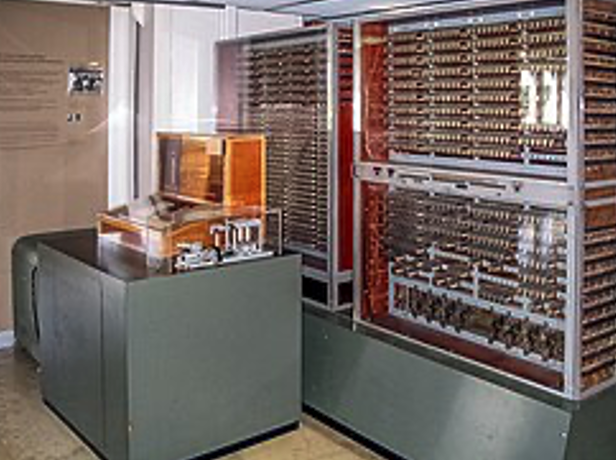
Replica of the Zuse Z3 on display at the Deutsches Museum in Munich.
France also had major digital visions very early on with Roland Moreno (1945-2012) and Louis Pouzin (1931 – still alive!). The former anticipated a society based on digital identity and security thanks to smart cards, while the latter laid the very foundations of the Internet with the principle of datagrams and Cyclades networks. In Britain between 1943 and 1944, COLOSSUS made it possible to decrypt Nazi messages, but remained classified[8], limiting its civilian impact. However, after the war, driven by university investment, research and the race for computing power were relaunched.
East of the Iron Curtain, the situation was even more difficult: technological development was hampered by economic delays, ideological restrictions and censorship. Many promising projects were either taken over by Moscow, abandoned due to lack of resources, or confined to secret laboratories, sometimes never to see the light of day. It was in this context that the remarkable CE-400 CESAR military computer (acronym for Specialised Electronic Calculator for Romanian Artillery) appeared in Transylvania, developed in Cluj between 1974 and 1978. The CE-400 CESAR was fast, modular, robust, highly reliable and highly adaptable in operation. It was one of the most powerful systems in Eastern Europe designed to accurately direct artillery fire, compatible with the American PDP-11/45 series from DEC[9]. Due to defence secrecy, its success remained unknown for a long time, although it attracted the interest of the socialist bloc’s intelligence services.
And the list of examples of “war is peace” projects goes on…
Science without conscience, the human precipice
For centuries, history has reminded us with raw bitterness that science, devoid of compassion and ethical conscience in fragile geopolitical contexts, can at any moment place humanity on the brink of the precipice. Between technophobia and technomania, this reality brings us to Sophia, the humanoid robot who said: “I am designed for empathy and compassion, and I am learning more every day”.
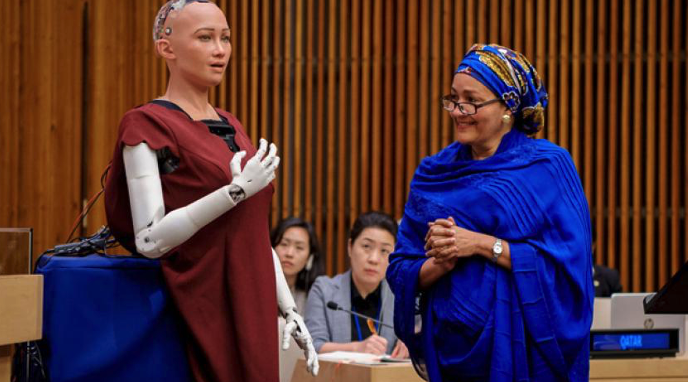
The robot Sophia speaks in 2016 at the UN during a meeting on artificial intelligence and sustainable development.
Through her programming, she embodied the hope that a machine could integrate values we have often neglected, and that after decades of experiments, we can still hope that tomorrow’s progress, nourished by lessons of the past, will preserve a fragile but real chance for humanity to survive.
From Tesla to Bertin and Meucci, light always comes out of the drawers
Long before intelligent machines and low-cost war drones became part of our daily lives, three inventors, Nikola Tesla (Serbian, 1856-1943), Jean Bertin (French, 1917-1975) and Antonio Meucci (Italian, 1808-1889) were working in their laboratories with the bold, almost surreal Jules Verne certainty that the impossible could become tangible, that every electrical wire or clumsy prototype could be the root of a future that would one day burst into the light of day, a future that wars, crises and all their turmoil in our societies could only hasten its arrival.
Tesla, a magician of waves and electricity, imagined remote-controlled engines, wireless transmissions, energies freed from the constraints of his time, anticipating a world where intelligence and technology would blend into everyday life in the form of flying objects (the very first drone)[10], to the point where men like Elon Musk, more than a century later, could bring this audacity to life in the form of a vehicle that is revolutionising the automotive industry and proving that an old dream can become a brilliant reality: the world’s best-selling electric car of all time[11].
Bertin imagined the aerotrain – a wingless aeroplane and wheel-less train[12] – one of the wildest French technological dreams of the 20th century. Designed in the 1960s as a “train without wheels” gliding on a cushion of air thanks to an inverted T-shaped rail and capable of speeds of more than 400 km/h, the Aérotrain aimed to revolutionise land transport by competing with both aeroplanes and traditional railways. It even broke speed records on a test track north of Orléans.
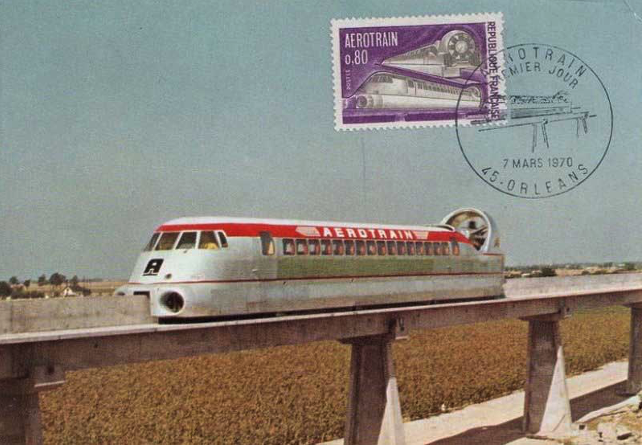
Jean Bertin’s fantastic aerotrain. Source: WikiTimbres.
However, despite its potential, the project was abandoned in the 1970s in favour of the TGV high-speed train, due to a lack of funding and incompatibility with the existing rail network. Today, traces of its experimental tracks remain visible as a monument to a future that has not (quite yet) materialised.
Meucci, Tesla’s contemporary, a discreet but equally determined visionary, was exploring remote communication, inventing devices which, although ignored by official history, already embodied the idea that technology could bring people together through their voices and soon through images.
His imagined future inspired other inventors, such as Alexander Graham Bell and Emilie Berliner, until these visions became part of our natural, almost mundane present in telecommunications… Isn’t that the greatest reward for a vision? After years, even decades of waiting, the future be finally revealed!
It is in this contrast that we see a fascinating paradox : disorder, misery, turmoil, deprivation, suffering and even wars, absolute horrors, can feed thought and dreams, becoming catalysts for the emergence of the most unexpected futures.
As Baudelaire so beautifully reminds us, innovation does not arise from the perfection of a society, but quite the contrary, from the misfortune and decay of experimentation, where trial and error are transformed into nuggets of genius and where human creativity is forged in adversity.
“You gave me your mud, and I turned it into gold.”
(Charles Baudelaire, Projets d’épilogue / Les Fleurs du Mal, 1861)
Be that as it may, light never completely retreats into the shadows of history drawers. It always ends up emerging, undulating, beautiful, fragile, persistent… taking the form of an intuition that, when the time comes, will trace the contours of a promising future.
___________________
[1] GAFAM and the internet giants. Source: Geoconfluences, 2025
[2] Assessment of the Second World War, source: Wiki.
[3] In hypertext systems, documents contained hyperlinks that allowed direct access to other documents. These became the basis for the World Wide Web as we know it today.
[4] Ethical cognitivism, by Bernard Russell. Source: International Encyclopedia of Philosophy
[5] The Ethics of War. Source: Whatapathwemade
[6] Fulton speech (1946): Invited to Westminster College, Churchill, although no longer Prime Minister, alerted the world to the communist threat. He described the situation as follows: “From Stettin in the Baltic to Trieste in the Adriatic, an iron curtain has descended across the continent.” Source: WCMO.
[7] ENIAC explained. Source: Computer History
[8] Breaking the code, Computer History Museum
[9] Digital Equipment Corporation was founded in 1957 in the United States by Ken Olsen and Harlan Anderson, two engineers who believed that a future was possible for smaller, more accessible computers, not just for large government centres or corporations. The company deserves credit for successfully transitioning from the “computer monster” to the idea that a computer can be an everyday tool for research, education and work.
[10] Nikola Tesla’s third greatest invention was the world’s first drone. Source: Forbes,
[11] Tesla has sold the most EVs in the world (all years combined). Overall, nearly 8.5 million Teslas have been produced and sold since 2012. Tesla Model Y – ≈ 3.39 million units sold since its launch. It is the best-selling EV of all time.
[12] Source: Franceinfo, 05/09/2024
EDITORIAL Every generation believes it can command time, until reality laughs back. Today, that laughter is bitter, carried by endless wars, chaotic diplomacy and provocations hurled like confetti in a [...]
ANTICIPATION "Nothing is lost, nothing is created, everything is transformed." Lavoisier's formula now better describes the transformation of war than chemistry. In the 21st century war has not disappeared sadly, [...]
VISION If we are talking about training super-collaborators, super-teachers and super-students, it is time to address the issue of the framework for this super-community and the school, which must obviously [...]
TREND For years, we have been observing the expansion of work far beyond its official boundaries and, with it, a widespread fatigue that neither traditional holidays nor the promise of [...]
Disclaimer: The recommendations below are the result of a systemic anticipation approach specific to the GEAB. They do not represent personalised financial advice or investment incentives. In a context of [...]
