
EXPLORACTION
Since the theme of this issue is the monetisation of concepts – peace, in this case – the communal experience of The Burning Man in Black Rock City strikes us as a model of monetisation that also deserves our attention: it is a form of reinvention of human governance where giving functions as the sole currency of exchange, a thoughtful transformative experience reminding us that humans are defined by their ability to connect, to cooperate, to give, to invent, to love and to push themselves to the limit.
The Burning Man: Cooperate to survive
Contemporary societies are not short of living laboratories, but not all of them test the same things, nor do they operate on the same anthropological assumptions. For forty years now, the town of Black Rock in the United States has been experimenting annually, for a limited period (one week), with the total suspension of money (except for the participation ticket, which is very expensive, by the way) and the primacy of gift-giving as a form of citizen management, all underpinned by internalised ecological responsibility under extreme natural constraints (the MOOP principle / leave no trace![1]). People are at the centre of it all, more vulnerable than ever, dependent on the goodwill of other people and therefore 100% obliged to cooperate in order to survive. There, going it alone is impossible. Moreover, as you may have noticed, in the Burning Man camps, cooks, fitters, electricians, handy-dandies, and engineers are the most sought-after—and highest-paid—service providers for those less skilled in the art of making do with almost nothing.
How can one imagine governing effectively, and without coercion, nearly eighty thousand people of great diversity, who set up camp each year in a festival-city to be built and then dismantled? Definitely a form of hybrid management based on an internal structure governed by ten fundamental principles[2]: integration, immediacy, autonomy, participation, gift, decommodification, self-expression, civic responsibility, community effort, leave no trace!
Login
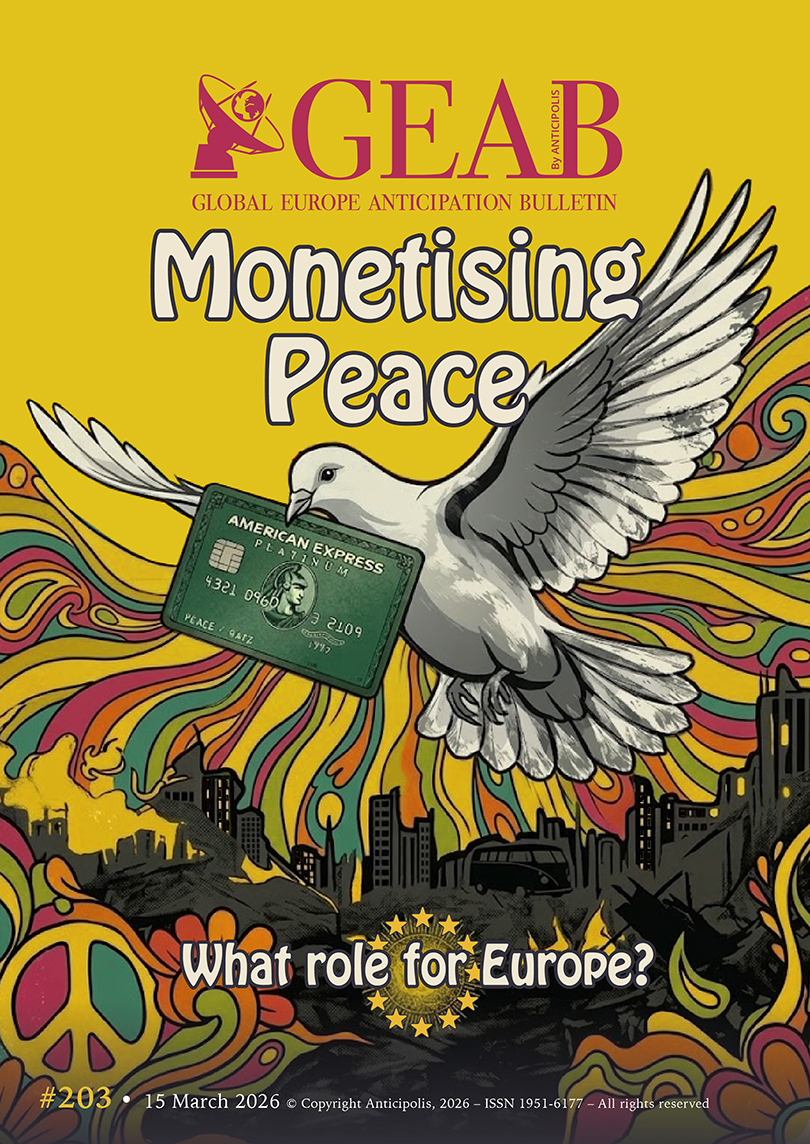
EDITORIAL The phase of Permanent Systemic War we identified in January as the next stage of the Global Systemic Crisis, has already been confirmed. Contrary to the intentions of the [...]
ANTICIPATION The “Board of Peace” (BoP), announced with great fanfare by Donald Trump on 22 January in Davos, illustrates the emergence of a market that is particularly attractive to the [...]
CALENDAR 15 March - Vietnamese National Assembly elections In a spirit of transparency and public engagement, Ms Nguyen Thi Thanh, Vice-President of the National Assembly, and Ms Vu Viet Trang, [...]
ALERT In less than a century, the international peace architecture has shifted from a universal project of global regulation to a politically paralysed and financially strangled structure. By the end [...]
Disclaimer: The recommendations below are the result of a systemic anticipation approach specific to the GEAB. They do not represent personalised financial advice or investment incentives. In a context of [...]
