EVENT
In 2026, Switzerland will assume the chairmanship of the Organisation for Security and Cooperation in Europe (OSCE) for the third time – following 1996 and 2014[1]. This term of office comes at a time of upheaval: the war in Ukraine, an open crisis of multilateralism, the erosion of trust-building mechanisms between states, and a pace of technological change that outstrips the capacity of existing diplomatic frameworks to respond. Due to its history (the 1975 Helsinki Accords), the Ukrainian crisis has not led to Russia’s expulsion from the Organisation. As the OSCE’s decision-making system is based on consensus, the Organisation is therefore undergoing an executive crisis that gives it time to reinvent itself. For Bern, this presidency is both a classic diplomatic exercise and a test of the relevance of a neutrality still capable of maintaining channels of dialogue in a persistently polarised international environment.
A presidency of continuity, an unprecedented context
Switzerland is aligning its presidency with its foreign policy, the promotion of international law, good offices, mediation, conflict prevention and a commitment to multilateralism; as well as its announced priorities for 2026: reaffirmation of the Helsinki principles, inclusive multilateral diplomacy, anticipation of emerging technologies, human rights and strengthening the OSCE’s capacity to act[2], which reflect a clear commitment to preserving a framework of cooperative security where it is deteriorating most rapidly. Switzerland’s interests here align with those of the organisation as a whole. The OSCE remains one of the few institutional forums where the 57 participating States – from Vancouver to Vladivostok, with radically incompatible political profiles – can still engage with one another without completely severing diplomatic ties. Given that bilateral channels between major powers have largely closed and that the UN Security Council is paralysed, this residual function is not insignificant; it may even be irreplaceable.
Login
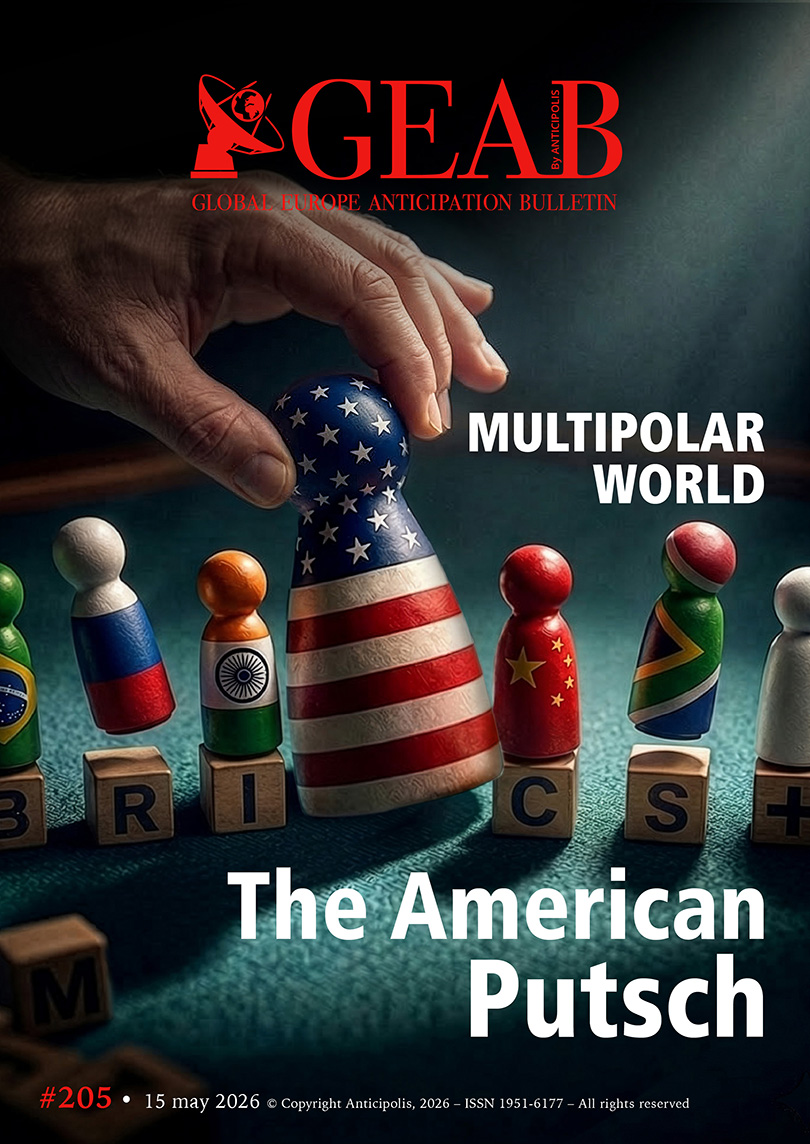
EDITORIAL For the past 20 years, we'been observing, analysing and anticipating as best we can the stages of the massive transition from a functional Western-centred world to a functional multipolar [...]
ANALYSIS Anthony Trad, Geopolitical Analyst Chairman of Stradegy Advisory For over 20 years, the GEAB has been studying the transition from a relatively simple Western-centred world – characterised by [...]
ANTICIPATION If we are correct and Donald Trump’s America is systematically dismantling all the ties paralysing and crushing the United States, preventing it from taking its place as ‘primus inter [...]
AGENDA 14–15 May – BRICS+: new candidates, new challenges The BRICS foreign ministers are meeting on 14 and 15 May 2026 in New Delhi under the Indian presidency, a gathering [...]
VISION I was sixteen. It was December 1983. WarGames had just come out. I saw it back then, as a teenager, and something took root inside me. A fascination with [...]
Disclaimer: The recommendations below are the result of a systemic anticipation approach specific to the GEAB. They do not represent personalised financial advice or investment incentives. In a context of [...]
