ANALYSIS
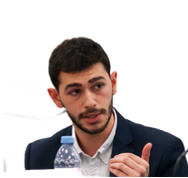
Anthony Trad, Geopolitical Analyst
Chairman of Stradegy Advisory
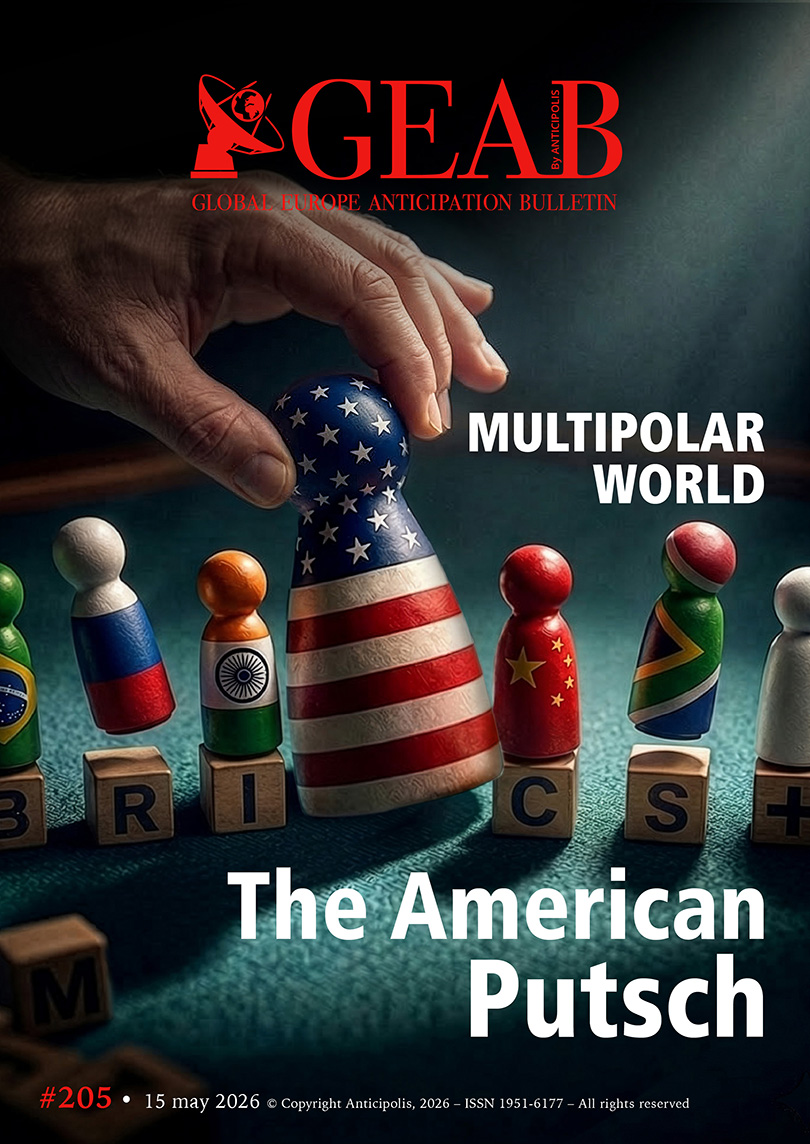
For over 20 years, the GEAB has been studying the transition from a relatively simple Western-centred world – characterised by the absolute technological, cultural, political, financial and economic superiority of a historically coherent alliance of actors (‘the West’) over the rest of the world – to a complex (multipolar) world – comprising a diversity of major players in relative technological equilibrium and possessing sovereign strategic assets. This diversification of major players has implications not only for international institutions and governance superstructures. All commercial and financial infrastructures, as well as the operating modes of all flows traversing the planet, are being changed. Unfortunately, reforming these mechanisms is proving more difficult than one might have hoped. And only major systemic shocks seem capable of breaking down the old system to allow the new one to emerge.
Such was the case with the Covid crisis, which, by bringing global economy to a standstill, allowed new routes to open up, breaking the West’s star-shaped supply network. The war in Ukraine, by creating a barrier of fire on the routes to the west for Russian gas and oil, is enabling all Russian energy flows to be redirected eastwards and southwards (to China and India in particular). The Israel-Iran conflict, meanwhile, is putting into perspective the centrality of the Middle East in terms of hydrocarbons and that of the Strait of Hormuz as the only route to a multipolar world hungry for energy: diversification will be essential… and, as a result, we must take a new step towards ‘de-simplifying’ the global system, which is vital to restoring its stability.
In fact, of the 80-90% of trade that passes through the oceans, at least two-thirds passes through seven ‘choke points’ whose combined width is no greater than the distance between Paris and Brussels[1]. Hormuz: 34 km. Malacca: 2.7 km. Bab el-Mandeb: 29 km. Suez Canal: 300 m. Bosphorus: 700 m. Panama: 33 m. Taiwan Strait: 130 km[2].
Login
EDITORIAL For the past 20 years, we'been observing, analysing and anticipating as best we can the stages of the massive transition from a functional Western-centred world to a functional multipolar [...]
ANTICIPATION If we are correct and Donald Trump’s America is systematically dismantling all the ties paralysing and crushing the United States, preventing it from taking its place as ‘primus inter [...]
AGENDA 14–15 May – BRICS+: new candidates, new challenges The BRICS foreign ministers are meeting on 14 and 15 May 2026 in New Delhi under the Indian presidency, a gathering [...]
EVENT In 2026, Switzerland will assume the chairmanship of the Organisation for Security and Cooperation in Europe (OSCE) for the third time – following 1996 and 2014. This term of [...]
VISION I was sixteen. It was December 1983. WarGames had just come out. I saw it back then, as a teenager, and something took root inside me. A fascination with [...]
Disclaimer: The recommendations below are the result of a systemic anticipation approach specific to the GEAB. They do not represent personalised financial advice or investment incentives. In a context of [...]
