
EDITORIAL
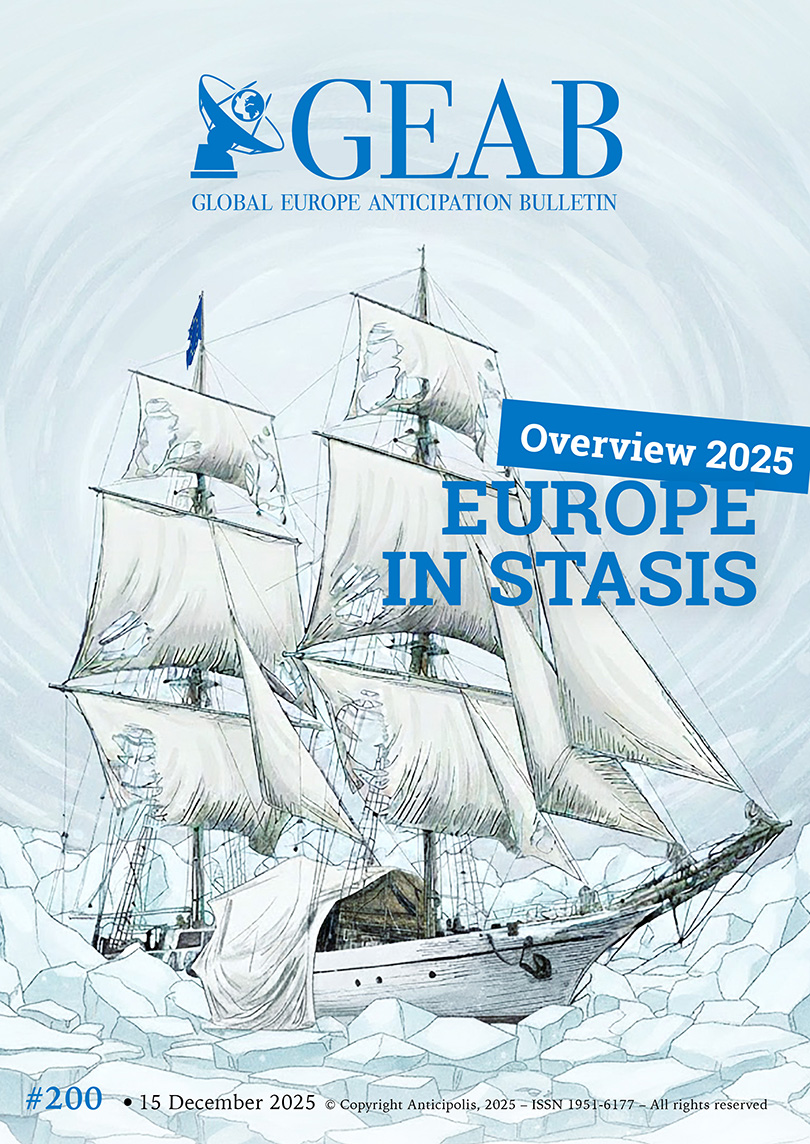
By failing to broker a peace agreement between Ukraine and Russia at the beginning of the year, and lacking the means to enable Ukraine to prevail militarily, Europe has added yet another year to its own decline, as well as to the suffering of the war’s victims. The opportunity we saw in March[1] to make an irresistible proposal to Russia (and the United States) around the Arctic, as a pathway out of the crisis, was not seized (it was not even mentioned).
Instead, nothing happened. The war dragged on. The United States disengaged[2]… Europe gained nothing, did nothing, said nothing, and found itself increasingly “alone, facing its own demons”[3]. It keeps imposing sanctions, legislating, maintaining the status quo, probably frightened by the prospect of the immense reform that awaits it after the war and which it does not have the political capacity to carry out. And with each passing week, Europe loses important ground in a world so rapidly changing… without it. Yet, our continent was well positioned in 2021 : having successfully negotiated the strategic advantage provided by Donald Trump’s first election in the United States, foreign direct investment (FDI) was pouring in[4], the American tech companies were investing in Europe[5], the French Tech was winning people over[6], the ScaleUp programme was directing investment towards European start-ups (with annual growth higher than in the United States)[7], and so on.
Admittedly, the war in Ukraine has stimulated investment in European (military) technologies[8]. However, foreign investment into the EU has been declining since 2022 (-5% in 2024)[9]. The omnipresence of the United States (largely personified by Mr. Trump) in Western media, persistent geopolitical uncertainty in Europe and the EU’s growing focus on its eastern border to the detriment of broader global engagement have quickly pushed the Old Continent off the global radar. As a result, Europe is no longer perceived as a priority partner by African countries, which now rank the US and China ahead of it[10]. It has also ceased to count as a significant geopolitical player in the Middle East[11]. In Asia, key actors (India, ASEAN countries, Japan, South Korea) tend to seek multiple partnerships, thereby automatically reducing the EU’s unilateral influence compared to that of China or the US[12].
This trend is not new. The launch of the European GlobalGateway programme at the end of 2021 aimed to slow down or even reverse the process. However, the initiative is now widely criticised and appears to have damaged Europe’s global image rather than the opposite[13].
In reality, the EU’s main problem is one of perception (after governance, of course). The state of European technology is far less bleak than is often portrayed, but this fact struggles to turn into influence, visibility, or strategic credibility on the global stage[14].
Moreover, the continent’s technocratic interface with the outside world, the provincialism of the media ecosystem and the attention-grabbing tactics mastered by Donald Trump, all converge with the strategic and political impotence of a Europe weakened by its internal divisions.
These very divisions could, under different circumstances, constitute huge added value (diversity, agility, creativity, etc.) were it not for a final fantasy of Union that seeks to flatten Europe’s linguistic, cultural, legislative, political, and geopolitical realities beneath a steamroller of standards and injunctions.
After a year of stagnation, we must drink the cup to the dregs.
The humiliating chapter on Europe in the National Security Strategy is making its way around the world, highlighting all the weaknesses commonly acknowledged both inside and outside the EU, and suggesting that the continent be placed under US tutelage[15] to prevent it from falling into “civilisational collapse”.
America is not letting go of Europe, far from it. It is humiliating it, bringing it to Canossa, and imposing its vision of the new realities of a multipolar world in whose design it will not participate, punished for having failed to avoid the first war of this new geopolitical configuration (the Euro-Russian war over Ukraine).
The fact that the United States, with its trillions of dollars of public debt, its talent deficit[16], and the abject poverty of its society[17], can inflict such a defeat on the EU speaks volumes about the political failure of the European project. As for Russia, weakened by this war and permanently cut off from Europe, it now has only the United States as a Western representative capable of limiting its subjugation to China.
It has also just marked a break with its former European partners by unilaterally terminating the defence and military cooperation agreements that bound it to France, Portugal and Canada[18]… Furthermore, as if that were not enough, the EU continues to alienate China by applying the anti-subsidy rules of the Foreign Subsidies Regulation (despite being designed in response to the US Inflation Reduction Act[19]) solely to Chinese companies[20].
All this while America is ushering in an era of multipolar cooperation by agreeing to a US-China[21] “great reconciliation” (to reuse the expression from last May’s GEAB[22]).
Without vision, without political legitimacy, incapable of reform and now isolated on the international stage… Europe is preparing to go to Canossa, soon forced to accept a peace treaty acknowledging Ukraine’s defeat (and, by extension, its own), silent in the face of American insults, compelled to abandon the core principles of the old model of so-called multilateral governance, confronted at last with the realities of a multipolar world – one hardened by 15 years of denial.
Yet this peace has not been signed. And bleak as this scenario may be, it remains the least disastrous among those still in play for 2026. As we wrote in 2023, must the multipolar world be built on the ruins of Europe?
To access the full issue, please log in or register here

Marie-Hélène Caillol
Managing editor
| 20 years ahead…
Don’t miss the next issue, which will mark a major milestone: 20 years, 201 issues, 6,000 pages of anticipations and analyses devoted to the Global Systemic Crisis… … 10,000 loyal or occasional subscribers, hundreds of thousands of followers… Back in January 2006, who could have imagined that we would still be here in 2026, offering an original, independent and relevant perspective on the strange and often painful period of history that Europe, and humanity as a whole, are going through? So next month, we will take stock of these 20 years and look ahead to the next 20 in search of certainties, challenges and hope… despite everything. The cover of this special anniversary issue will be designed by comic book author Beb Deum ! |
________________
[2] Source: The Conversation, 09/12/2025
[4] Source: UNCTAD, 19/01/2022
[5] Source: IOPlus.nl, 08/12/12021
[7] Source: BusinessChief, 09/12/2021
[8] Source: The Gaze, 30/04/2025
[11] Source: Brussels Reporter, 29/06/2025
[12] Source: Konrad Adenauer Stiftung, 28/10/2024
[13] Sources: Rosa Luxemburg Foundation, 26/09/2023; Counter-Balance, 15/07/2025
[14] Source: Observer, 08/12/2025
[15] The American objective “should be to help Europe correct its current trajectory”. Source: Toute l’Europe, 08/12/2025
[16] Source: Staffing Industry Analysts, 06/03/2025
[17] Source: The Global Statistics, 2025
[18] Source: Euronews, 06/12/2025
[19] Source: Euractiv, 15/03/2024
[20] Source: South China Morning Post, 12/12/2025
[21] Source: Hogan Lovells, 13/11/2025
ANTICIPATION Europe, the Middle East, Australia, South Korea... within this highly competitive multipolar world, many medium-sized space powers are becoming major players. Alongside the new age of aeronautics (drones), digital [...]
TREND The fashion industry has experienced its share of disruption, but until recently, this was still the preserve of European companies. Sweden's H&M, Spain's Mango and Zara (above all) invented [...]
EVALUATION 2025 - A year of very promising anticipatory lines As every December, this exercise is not about playing fortune tellers, but about assessing how far the real world, which [...]
WEAK SIGNALS When discussing the future of European fashion, one fact is immediately clear: our wardrobes will never again be mere collections of colorful fabrics. By 2040, what we wear [...]
Disclaimer: The recommendations below are the result of a systemic anticipation approach specific to the GEAB. They do not represent personalised financial advice or investment incentives. In a context of [...]
